News

A new research paper has been published in Seismological Research Letters

Our latest study has just been published in Seismological Research Letters (SLR), Seismological Society of America:

Cruz, A., Ghasemi, M., Karimzadeh, S., Karimzadeh, S., Aksan, A., Matsuoka, M., & Lourenço, P. (2025).
📰 28 March 2025 Myanmar earthquake: Strong ground motions, macroseismic intensity, liquefaction and ALOS-2 ScanSAR remote-sensing damage observations.
🔗 https://pubs.geoscienceworld.org/ssa/srl/article/doi/10.1785/0220250258/661962/28-March-2025-Myanmar-Earthquake-Strong-Ground

This work integrates ground motion records, macroseismic data, liquefaction evidence, and ALOS-2 ScanSAR remote sensing to analyze the 2025 Myanmar earthquake and its impacts.

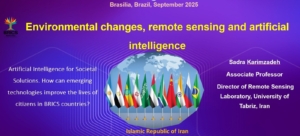
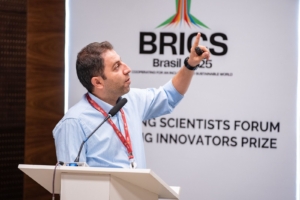
Dr. Sadra Karimzadeh attended in 10th Young Scientists Forum of BRICS in Brazil

Dr. Sadra Karimzadeh attended in 10th Young Scientists Forum of BRICS in Brazil from 14th September to 17th September in Brasilia city in Brazil. He presented about , “Environmental Changes, Remote Sensing, and AI,” with a focus on how these emerging technologies can enhance the lives of citizens in BRICS countries and beyond. He emphasized their critical role in saving lives through improved disaster preparedness, response, and recovery.


ISPRS برگزاری ورکشاپ آموزشی در زمینه تصویربرداری ابر طیفی در هشتمین کنفرانس بین المللی اطلاعات مکانی 

دکتر صدرا کریم زاده مدیر آزمایشگاه سنجش از دور دانشگاه تبریز در حاشیه هشتمین کنفرانس بین المللی اطلاعات مکانی در دانشگاه تهران ورکشاپی با عنوان

“Important tips for hyperspectral imagery using HYSPIM desktop system”

.برگزار خواهد کرد


.علاقمندان می توانند برای کسب اطلاعات بیشتر به وبسایت همایش مراجعه کنند

https://geospatialconf2025.ut.ac.ir/p_workshop-dr-karimzadeh

Dr. Sadra Karimzadeh, the director of RSLUT has been elevated to senior member grade of IEEE GRSS (Geoscience and Remote Sensing Society)

Dr. Sadra Karimzadeh has been recognized as a Senior Member in good standing. This prestigious distinction highlights Dr. Karimzadeh commitment to technological advancement and his contributions to the field of geoscience and remote sensing.
Must be noted that only 10% of the IEEE are the senior members.

ALOS-2 ScanSAR RGB Change Map

Three PALSAR-2 ScanSAR images were used for disaster response:

Pre-seismic: 2025.01.16 & 2025.02.19

Co-seismic: 2025.03.30

Orbit and angle: Descending, 39.02 degree

Normalized pre-seismic coherence – co-seismic coherence represents “red” channel.

Normalized co-seismic coherence – pre-seismic coherence represents “green” channel.

Averaged pre-seismic and co-seismic coherence represents “blue” channel.

Link.Kmz

ALOS-2 ScanSAR Damage Proxy Map

Three PALSAR-2 ScanSAR images were used for disaster response:

Pre-seismic: 2025.01.16 & 2025.02.19
Co-seismic: 2025.03.30

Orbit and angle: Descending, 39.02 degree

Coherence estimation was performed for pre-seismic and co-seismic pairs at 20 m pixel spacing.
Using Jenks classification, the results were categorized as follows:

Blue pixels: Likely “no change” (stable areas)

Yellow and orange pixels: Likely “Moderate changes”

Red pixels: Likely “High changes”

Link.Kmz

Damage proxy map following M 7.7 Myanmar earthquake

We have processed the Sentinel-1 images from ascending orbits over Myanmar to generate urban damage maps in heavily damaged areas like Mandalay and Naypyidaw.
If you like to see the whole possibly damaged areas in Google Earth, here is the *.kmz file: https://drive.google.com/file/d/1_vuOM4qQh4W4L81RdF9_IBxA5ZLzxU2i/view

PDF link

Initial Damage Assessment of the M 7.7 Myanmar Earthquake for Bangkok, Thailand

Following the devastating M 7.7 earthquake in Myanmar, our team rapidly generated the first damage map using ALOS-2 PALSAR-2 satellite data.

Thanks to timely ALOS-2 observations over Bangkok, we were able to conduct preliminary damage analysis. The coherence difference products serve as critical indicators of post-event changes.
The larger the coherence difference, the more change was observed after the
earthquake.

PDF link


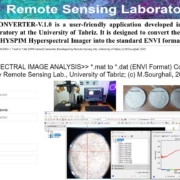
HYSPIM-CONVERTER V.1.0 is released!

HYSPIM-CONVERTER-V.1.0 is a user-friendly application developed in the Remote Sensing Laboratory at the University of Tabriz. It is designed to convert the *.mat output format of the HYSPIM Hyperspectral Imager into the standard ENVI format.
Download link: here